ConservationBytes.com

Conservation research … with bite
  • Home
  • About
    • Policy
  • Top 20
  • Cartoons
  • Classics
    • Pollination
  • Potential
  • Toothless
  • Australiana
    • Dingoes
  • CJA Bradshaw
    • Publications
    • Media appearances
    • Public speaking
    • Curriculum Vitae
  • Tips

Cartoon guide to biodiversity loss III

24 02 2009

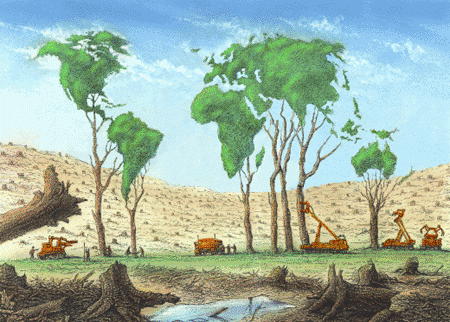
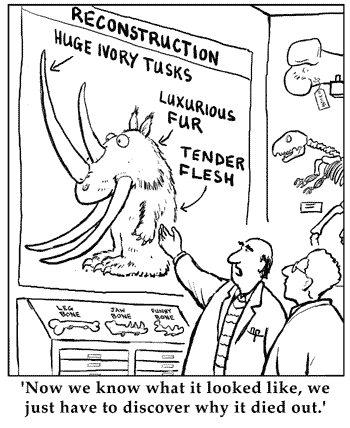
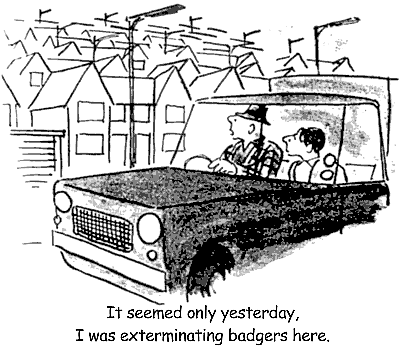
Some more (see previous ‘Cartoon Guide’ instalments I and II) comedic reminders of humanity’s environmental short-sightedness.

—
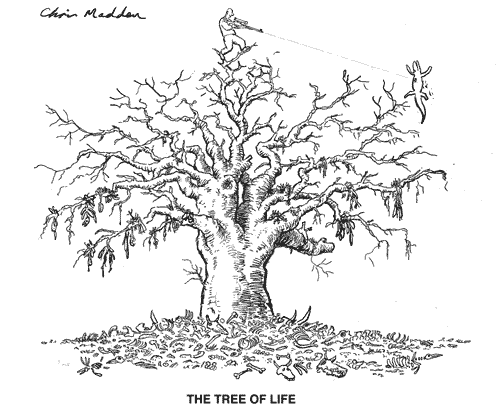
The Call of The Wild

CJA Bradshaw

Add to FacebookAdd to NewsvineAdd to DiggAdd to Del.icio.usAdd to StumbleuponAdd to RedditAdd to BlinklistAdd to Ma.gnoliaAdd to TechnoratiAdd to Furl

Share:

  • Click to share on Bluesky (Opens in new window) Bluesky
  • Click to share on Mastodon (Opens in new window) Mastodon
  • Click to share on LinkedIn (Opens in new window) LinkedIn
  • Click to share on Reddit (Opens in new window) Reddit
  • Click to share on Facebook (Opens in new window) Facebook
  • Click to share on Pinterest (Opens in new window) Pinterest
  • Click to share on Pocket (Opens in new window) Pocket
  • Click to share on Tumblr (Opens in new window) Tumblr
  • Click to share on Telegram (Opens in new window) Telegram
  • Click to share on WhatsApp (Opens in new window) WhatsApp
  • Click to email a link to a friend (Opens in new window) Email
  • Click to print (Opens in new window) Print
Like Loading...

Related

« Don’t torture your readers II One more (excellent) reason to conserve tropical forests »


Actions

  • rss Comments RSS
  • trackback Trackback

Information

  • Date : Tue, 24 Feb 2009
  • Tags: biodiversity, cartoon, conservation
  • Categories : cartoon, conservation, deforestation, ecosystem, ecosystem services, exploitation, extinction, habitat loss, human overpopulation, threatened species

Leave a comment Cancel reply


The science of ... saving life

CJAB

CJAB

I am the Matthew Flinders Professor of Global Ecology at Flinders University.

View Full Profile →

Follow ConservationBytes.com on WordPress.com

Stats

  • 3,365,093 views
  • GitHub
  • Google
  • Bluesky
  • Mastodon
  • Facebook
  • LinkedIn
  • Instagram
  • SoundCloud

Top Posts

  • Killing (feral) cats quickly (and efficiently)
    Killing (feral) cats quickly (and efficiently)
  • How to write a scientific paper
    How to write a scientific paper
  • Conservation and ecology journal ranks 2023
    Conservation and ecology journal ranks 2023
  • Conservation quotes: Attenborough to Irwin
    Conservation quotes: Attenborough to Irwin
  • The evil sextet
    The evil sextet
  • We're sorry, but 50/500 is still too few
    We're sorry, but 50/500 is still too few
  • Why a shrinking human population is a good thing
    Why a shrinking human population is a good thing
  • Which countries are the 'wealthiest'?
    Which countries are the 'wealthiest'?
  • How to make an effective marine protected area
    How to make an effective marine protected area
  • A long life can be a disadvantage
    A long life can be a disadvantage
Feb 2009
M T W T F S S
 1
2345678
9101112131415
16171819202122
232425262728  
« Jan   Mar »

RECENT POSTS

Fear of humans

Fear of humans

Many animals avoid contact with people. In protected areas of the African savanna, mammals flee more intensely upon hearing human conversations than when they hear lions or sounds associated with hunting. This fear of humans affects how species use and move in their habitat. Throughout our lives, we interact with hundreds of wildlife species without…

CJAB's avatar by CJAB Thu, 28 Aug 2025Thu, 28 Aug 2025
A long life can be a disadvantage

A long life can be a disadvantage

Deep-sea sharks include some of the longest-lived vertebrates known. The record holder is the Greenland shark, with a recently estimated maximum age of nearly 400 years. Their slow life cycle makes them vulnerable to fisheries. Humans rarely live longer than 100 years. But many other animals and plants can live for several centuries or even millennia, particularly…

CJAB's avatar by CJAB Thu, 12 Jun 2025Sat, 14 Jun 2025
Genetics to the rescue

Genetics to the rescue

Procreating with a relative is taboo in most human societies for many reasons, but they all stem from avoiding one thing in particular — inbreeding increases the risk of genetic disorders that can seriously compromise a child’s health, life prospects, and survival. While we all inherit potentially harmful mutations from our parents, the effects of…

CJAB's avatar by CJAB Tue, 27 May 2025Mon, 26 May 2025

Links

    Log in


    Create a website or blog at WordPress.com
    • Comment
    • Reblog
    • Subscribe Subscribed
      • ConservationBytes.com
      • Join 2,780 other subscribers.
      • Already have a WordPress.com account? Log in now.
      • ConservationBytes.com
      • Subscribe Subscribed
      • Sign up
      • Log in
      • Copy shortlink
      • Report this content
      • View post in Reader
      • Manage subscriptions
      • Collapse this bar
     

    Loading Comments...
     

      %d